
Curriculum
Science
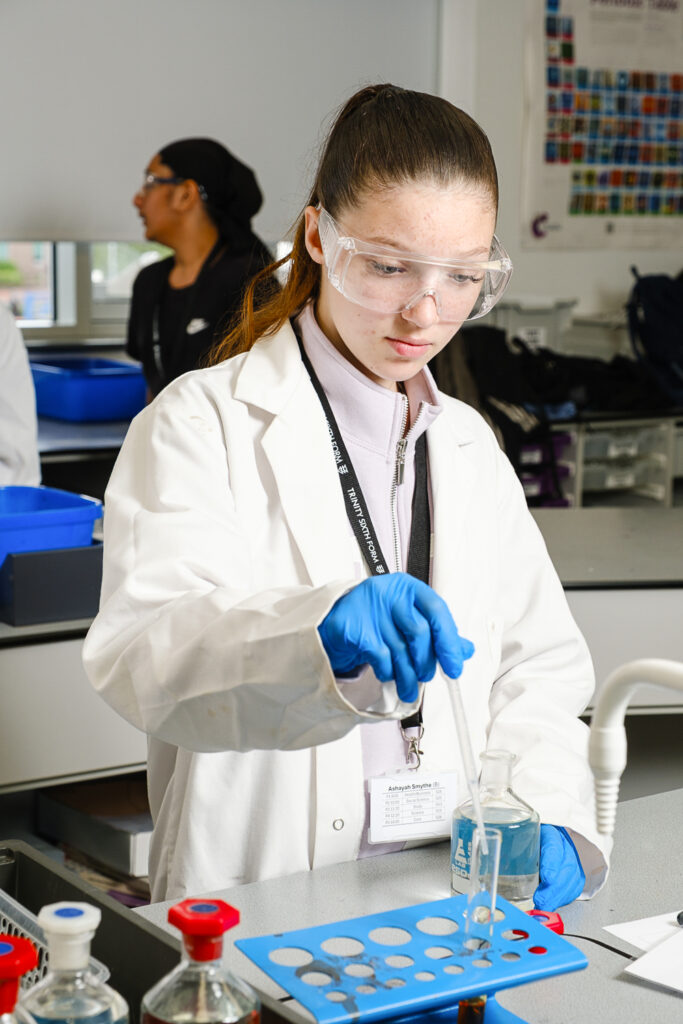
At Trinity we aim to ignite the natural curiosity of our students of the world around us through our teaching of science. Our curriculum explores the remarkable discoveries in science that have shaped our lives and how science can influence future technology that will change our world.
Our students are supported to gain a breadth of scientific understanding from studying life processes and how species interact within ecosystems, to how the properties of matter changes during chemical reactions and exploring the interaction between matter and energy, through observation and experiment. Our science curriculum allows students to recognise the significance of rational explanation and develop a sense of excitement about natural phenomena.
At Trinity we recognise the importance of working scientifically by developing enquiry skills established in the scientific method. These skills encourage the students to develop explanations, make predictions and analyse causes based on scientific theory. This method of teaching promotes and instils confidence in decision making. In the wider context our students learn to become independent problem solvers preparing them for future employment.
Students have a wide range of opportunities through our strong links with our local partners such as the University of Manchester and the Manchester Museum. These involve our students working with staff and students from these institutions both in school and off-site, at all levels – from Year 7 to Year 13. Our teaching team (both teachers and technicians) are supportive, enthusiastic, well-qualified subject specialists who are dedicated to get the best out of each one of our students.
The sciences are popular choices at Trinity, with many students opting to study three GCSEs (Biology, Chemistry and Physics) rather than the two compulsory (Combined Science). Our results have been consistently excellent with students achieving grades 8 and 9 across the three subjects. Our post-16 provision is broad, with A Levels in Biology, Chemistry and Physics and AAQs in Applied Science and Medical Science. Students make excellent progress from their GCSE starting points and have been accepted onto competitive courses such as medicine at leading Universities.
Science curriculum
| Autumn 1 | Autumn 2 | Spring 1 | Spring 2 | Summer 1 | Summer 2 |
|---|---|---|---|---|---|
| Chemical changes ( Chemistry) and Cells (Biology) | Sequences, Place Value and Ordering, Fraction, Decimal and Percentage Equivalence | Reproduction (Biology) and Digestion (Biology) | Digestion continued (Biology) and Forces (Physics) | Energy (Physics) | Space (Physics) and Forensics unit |
| Autumn 1 | Autumn 2 | Spring 1 | Spring 2 | Summer 1 | Summer 2 |
|---|---|---|---|---|---|
| Waves (Physics) and Forces (Physics) | Forces continued (Physics) and Body Systems (Biology) | Plant systems (Biology) and Health (Biology) | Health continued (Biology) and Separating techniques (Chemistry) | Separating techniques continued (Chemistry) | Earth |
| Autumn 1 | Autumn 2 | Spring 1 | Spring 2 | Summer 1 | Summer 2 |
|---|---|---|---|---|---|
| Interdependence (Biology) and Genetics and Evolution (Biology) | Acids and Alkalis (Chemistry) and Reactions (Chemistry) | Earth and its resources (Chemistry), Electricity (Physics) and Waves (Physics) | GCSE Energy (Physics) | GCSE Atomic Structure and The Periodic Table (Chemistry) | GCSE Cells (Biology) |
| Autumn 1 | Autumn 2 | Spring 1 | Spring 2 | Summer 1 | Summer 2 |
|---|---|---|---|---|---|
| Combined Science: Energy (Physics), Atomic Structure (Physics) and Electricity (Physics) Triple Science: Cells (Biology), Atomic Structure and The Periodic Table (Chemistry) and Atomic structure (Physics) | Combined Science: Particle Model (Physics), Cells (Biology) and Atomic Structure and The Periodic Table (Chemistry) Triple Science: Organisation (Biology), Structure and Bonding (Chemistry) and Energy (Physics) | Combined Science: Infection (Biology), Acids and Alkalis (Chemistry) Triple Science: Infection (Biology), Quantitative (Chemistry) and Electricity (Physics) | Combined Science: Infection (Biology), Acids and Alkalis (Chemistry) Triple Science: Infection (Biology), Acids and Alkalis (Chemistry) and Electricity (Physics) | Combined Science: Bioenergetics (Biology), Metals and Electrolysis (Chemistry) Triple Science: Bioenergetics (Biology), Metals and Electrolysis (Chemistry) and Particle Model (Physics) | Combined Science: Forces (Physics), Chemistry of the atmosphere (Chemistry) Triple Science: Homeostasis (Biology), Energy Changes (Chemistry) and Space (Physics) |
| Autumn 1 | Autumn 2 | Spring 1 | Spring 2 | Summer 1 | Summer 2 |
|---|---|---|---|---|---|
| Combined Science: Rates and Equilibria (Chemistry) and Forces (Physics) Triple Science: Homeostasis (Biology), Rates and Equilibria (Chemistry) and Forces (Physics) | Combined Science: Carbon Chemistry and Electromagnets and Waves (Physics) Triple Science: Inheritance (Biology), Carbon Chemistry and Magnetism (Physics) | Combined Science: Using Resources (Chemistry) and Homeostasis (Biology) Triple Science: Inheritance Continued (Biology), Using Resources and Waves (Physics) | Combined Science: Chemical analysis (Chemistry) and Inheritance (Biology) Triple Science: Ecology (Biology), Chemical analysis (Chemistry) and Waves Continued (Physics) |

